




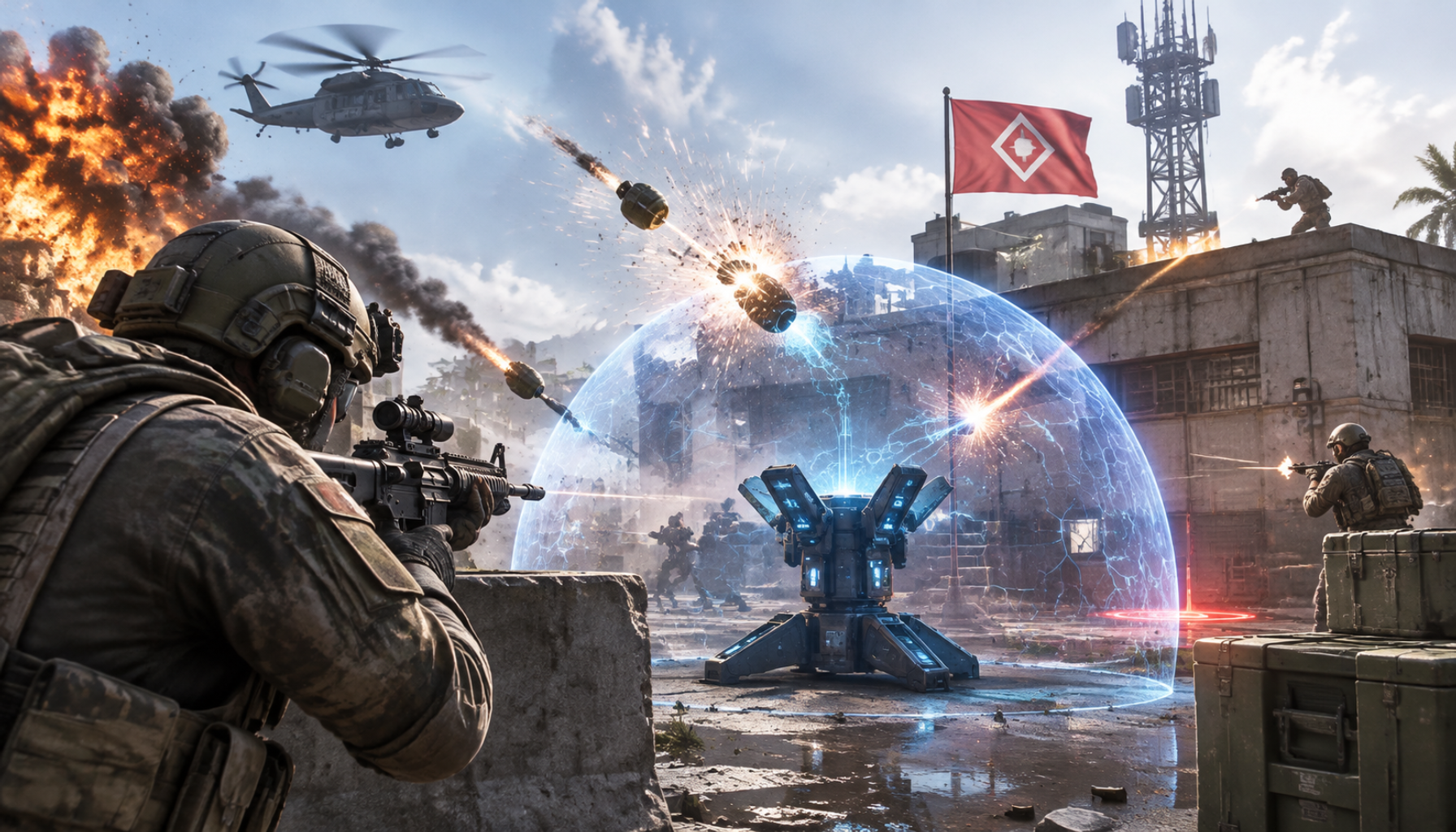
Explosives can quickly change the direction of a multiplayer match. A well-timed grenade can force defenders out of cover, interrupt an objective push, or create an opening for teammates to advance. In Modern Warfare 4, these attacks become less predictable when defensive equipment enters the fight. The Trophy System introduces another layer of protection by intercepting incoming projectiles, forcing attackers to reconsider how they approach contested positions. Players can use MW4 Bot Lobbies to practice recognizing explosive threats, adjusting their positioning, and understanding how defensive equipment affects different combat situations.
Explosives Create Pressure Around Key Objectives
Grenades and launcher projectiles play an important role in objective-based matches. In Domination, an explosive thrown toward a capture point can interrupt an enemy’s attempt to secure the area. During Hardpoint rotations, attackers may use explosives to challenge opponents holding a room before moving in to contest the next position. These situations make explosive equipment valuable for both disrupting enemy formations and creating opportunities for teammates.
However, repeated attacks can become predictable. Defenders who recognize a familiar throwing pattern may adjust their positions, while equipment designed to intercept incoming projectiles can prevent certain attacks from reaching their intended targets. This changes the decisions players make before committing to an assault.
The Trophy System is particularly relevant in these encounters because it directly challenges incoming projectile threats. Instead of relying entirely on cover or movement to avoid explosives, defenders can establish a limited protective area around an important position. Attackers must then consider whether a direct explosive approach is still worthwhile or whether another tactic would produce better results.
How the Trophy System Intercepts Incoming Threats
The Trophy System is a deployable Field Upgrade that destroys up to three airborne projectiles. It also has a Fast recharge speed and becomes available at Player Level 14. Larger targets require multiple shots to counter, which means its interception capacity depends partly on the type of incoming threat.
This combination makes the equipment useful in situations where several players are competing for control of the same area. However, its protection has clear limits. A Trophy System cannot guarantee that every incoming attack will be stopped, and its finite interception capacity gives opponents opportunities to adapt.
| Equipment Detail | Confirmed Information | Tactical Significance |
|---|---|---|
| Equipment Category | Field Upgrade | Provides deployable defensive support |
| Unlock Requirement | Player Level 14 | Available through multiplayer progression |
| Recharge Speed | Fast | Can become available again relatively quickly |
| Interception Capacity | Up to three airborne projectiles | Provides limited protection against incoming threats |
| Larger Targets | Require multiple shots | Consume more interception capacity |
One important detail is that the three-projectile limit should not be interpreted as three guaranteed interceptions against every possible target. Larger incoming objects require additional interception shots, making the distinction between projectile types important when evaluating the equipment’s effectiveness.
This limitation is also what makes the Trophy System interesting from a tactical perspective. It offers meaningful protection without completely removing explosive equipment from the battle. Attackers still have ways to challenge defended positions, but they need to consider how their resources are being used.
Attackers Must Adjust Their Explosive Strategies
An active Trophy System can make a direct assault less effective, particularly when defenders are holding a narrow entrance or a heavily contested objective. Throwing a grenade immediately after spotting an opponent may appear to be the obvious response, but the projectile could be intercepted before reaching its target.
Recognizing this situation is the first step toward a better attack. Instead of repeatedly using the same throwing angle, players can observe where interception occurs and reconsider their next move. This creates several practical decisions during an engagement:
- Check likely deployment positions before throwing valuable explosive equipment.
- Pay attention to interception activity to identify protected areas.
- Coordinate attacks with teammates instead of relying on repeated individual throws.
- Consider alternative entrances when the main approach is heavily defended.
- Change the timing of an attack when defenders become occupied with another threat.
For example, imagine a team attempting to enter a building occupied by several defenders. An initial grenade is intercepted near the main entrance, revealing that the approach is protected. Rather than sending additional explosives into the same area, one teammate can maintain pressure from the front while another moves toward a side entrance. This forces defenders to monitor multiple directions and makes it harder for them to concentrate their attention on a single attack.
The effectiveness of this approach comes from coordination rather than simply increasing the number of explosives used. A team that recognizes when its initial strategy is failing can preserve equipment and create a more favorable opportunity to advance.
Defensive Deployment Requires More Than Good Positioning
While attackers must learn to work around interception coverage, defenders have their own decisions to make. Deploying a Trophy System near an important position is only useful when its location supports the team’s overall defensive setup.
A device placed near a frequently contested entrance may help protect teammates from incoming projectiles. However, placing it somewhere easily bypassed can leave the actual objective vulnerable. Players should consider nearby cover, likely attack routes, and the areas where teammates are most likely to encounter explosive pressure.
Defensive coverage also needs to account for threats coming from different directions. A Trophy System protects its surrounding area, but it does not replace the need to watch alternative entrances or monitor enemy movement. If defenders focus entirely on the protection provided by the device, an attacking team may exploit an unguarded route.
Team coordination therefore remains essential. One player can maintain control of the main approach while teammates monitor flanking routes and watch for opponents attempting to move around the protected area. This allows the equipment to support the defensive formation without becoming the only part of the strategy.
The most effective deployment is not necessarily the one that protects the largest number of players. It is the one that provides useful coverage at the moment and location where explosive pressure is most likely to disrupt the team’s objective.
Equipment Choices Shape the Wider Tactical Battle
The Trophy System also influences how players approach their overall Field Upgrade selection. Every equipment choice involves a trade-off, and selecting a defensive option means considering what other tactical advantages might be available.
A player who regularly holds objectives may find the Trophy System useful because it helps reduce certain incoming projectile threats. Someone who prefers aggressive movement or reconnaissance may value a different Field Upgrade that better supports their role. Neither choice is automatically superior, since the most suitable equipment depends on the map, game mode, and team composition.
These decisions are closely connected to MW4 multiplayer loadout strategies, where equipment needs to complement the way a player approaches combat. Teams should also consider how their individual selections work together. If several teammates already provide defensive coverage, another player might contribute more by choosing equipment suited to aggressive movement or gathering information. Conversely, a team expecting heavy explosive pressure may benefit from having someone specifically responsible for protecting important positions.
The Fast recharge speed adds another consideration. Since the Trophy System is a Field Upgrade that recharges during the match, players should think about when deployment is likely to provide the greatest benefit. Using it during a relatively quiet moment may offer less value than saving it for an important objective fight.
Ultimately, equipment selection is not simply about choosing the item with the most obvious defensive or offensive benefit. Players need to consider how each option contributes to the team’s ability to control space, respond to threats, and maintain pressure throughout a match.
Trophy System Makes Explosive Warfare More Deliberate
The Trophy System changes the relationship between explosive attacks and objective defense by giving both sides additional decisions to consider. Attackers need to recognize interception coverage, manage their equipment more carefully, and look for openings beyond a protected entrance. Defenders must choose deployment positions that support their teammates without neglecting other routes of attack.
This interaction makes explosive warfare more than a matter of throwing grenades toward visible opponents. Timing, positioning, projectile capacity, and team coordination all influence whether an attack succeeds or a defensive setup holds. The equipment does not eliminate explosive threats, but it encourages players to approach them with greater awareness.
As Modern Warfare 4’s multiplayer experience develops, equipment interactions like this will remain an important part of how players build their strategies and adapt to different match situations. Players following seasonal content and promotional announcements can also keep an eye on CoD MW4 Redeem Codes for information about potential rewards and other available in-game opportunities.